Showing posts with label wintersow. Show all posts

Friday, June 10, 2011

Pulsatilla update

Here's a couple of Pulsatilla species that I sowed indoors around March 26th. They were transplanted into the cedar planter that I built in late May, and are still quite small (the second true leaves only developed after the transplant). That's a Canadian dime (same size as an American 10c piece) in the pictures for scale.

Pulsatilla campanella

Pulsatilla pratensis subsp. nigricans
Ink and Penstemon and I are having an informal grow-along. She reports that her black pasque flower is also still quite small, and that there's quite a long way to go before flowers can be expected. Hopefully they will survive to see that day. Year one, I suppose, is devoted to growing out those spindly roots.

The prairie crocus (Pulsatilla patens) seedlings that grew up with these guys didn't make it through the hardening-off process, but a seedling did appear May 30 in the wintersown pots, so there's hope yet.

Tuesday, May 31, 2011

Wintersowing 2011 Wrapup: What worked and lessons learned

In January and February, I set out a series of recycled plastic water containers filled with potting soil and sown with seed that could undergo or absolutely required cold stratification. I did a tally the other day to see how my wintersowing experiment went.


I was disappointed. Some seed performed excellently and a few did OK. But overall, most seeds had very poor germination rates (20% or less) or failed to germinate at all. I was shocked at the no-shows from what I would have thought were surefire wintersowing successes like the New England Aster and two of the three Asclepias species.

Wild chicory, one of the rare seeds liked wintersowing

It's possible that one contributing factor is the unusually wet and cold spring we have had; I read Monday that MontrĂ©al experienced double the average precepitation for this time of year. As a consequence, the potting soil was wet for prolonged periods of time and a lot of the containers became green with moss or (what is possibly) algae. I can see how the plants preferring quicker drainage would be unhappy.

Mossy!

Another possibility is seed source. All of the alpines were from Rocky Mountain Rare Plants' (RMRP) going out of business sale. None of them have been great performers wintersown or under lights (but worse when wintersown), despite many of them sold as easy 70°F germinators.

Amusingly enough, a few of the ungerminated pots surprised me with sprouts Monday morning when I went  to throw them out. This convinced me enough to keep some of the other containers with no apparent germination around for a little longer (**).

Would I repeat the experience? I'm not sure.

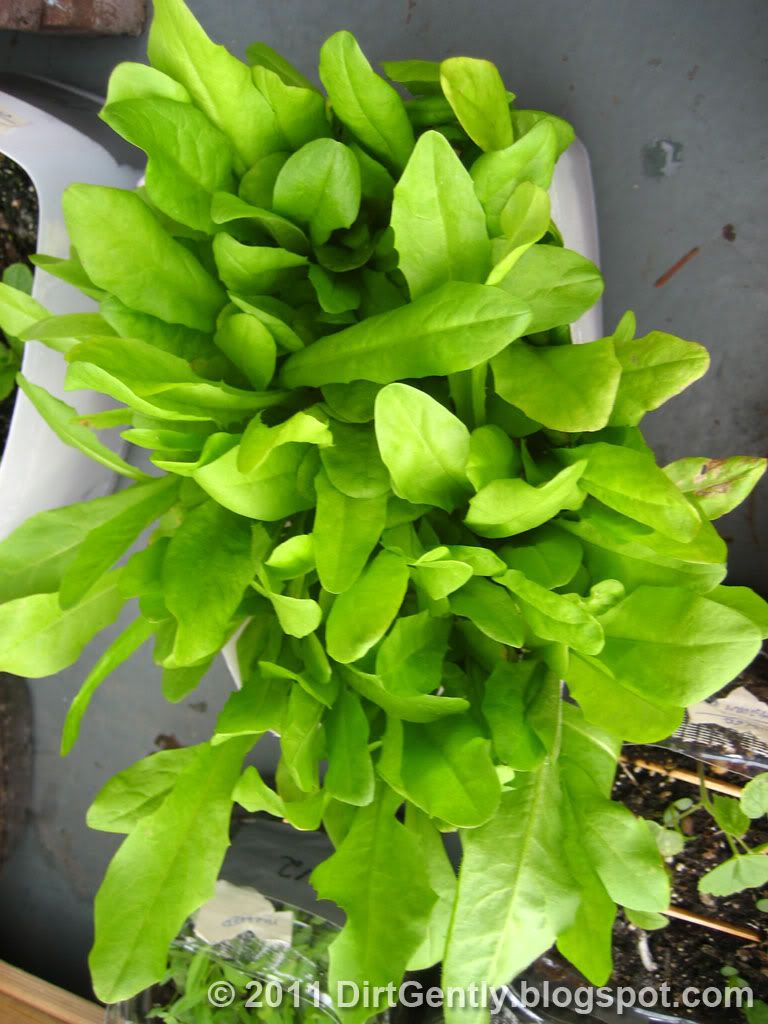
I would definitely plan better if I did it again. I struggled to find somewhere to plant the abundance from the excellent performers. The early emergence of the spinach and bok choy in April caught me completely off guard -- they bolted before I could get them in the ground as it were.

Happy bok choy, spinach, red orach

I would probably make up a custom, soilless mix rather than bagged el-cheapo potting mix to better control drainage and unwanted fungus / moss / algal growth. When it became clear that my containers were waterlogged, I found it difficult to add drainage with it already full of medium; it would be far easier to tape over extra drainage holes to reduce drainage than to make new ones.

But mostly, the large number of poor performers tempered any joy I had from seeing the other sprouts emerge even though I know that some of these might be hard to germinate under any circumstances.

The one huge benefit to wintersowing is virtually eliminating the need to harden off the little guys since they were exposed to the sun's deadly rays from the beginning (the containers were uncapped). I've managed to kill off or damage a not insignificant amount of seedlings grown under lights while hardening them off (and, it seems, the more precious the seedling to me, the more likely it would die a quick UV death) this spring. I've had zero deaths from hardening off in the wintersown bunch. To be extra cautious, I let them acclimatize to the elements for a couple of days by removing the duck tape keeping them shut, and then cut off the top of the containers altogether.


WINTERSOWING 2011 RESULTS (full spreadsheet here)
Excellent (80-100% germination)
Harebell (Campanula rotundifolia)
Black-eyed Susan (Rudbeckia fulgida 'Goldsturm')
Shasta Daisy (Leucanthemum × superbum 'Alaska')
Blanket flower (Gaillardia × grandiflora 'Goblin')
Milkweed (Asclepias syriaca) *
Rampion (Campanula rapunculus)
Chicory (Cichorium intybus)
An aster of some kind (100-0670) *
Spinach (Spinacia oleracea)
Bok choy (Brassica rapa chinensis)
Red orach (Atriplex hortensis)

OK (50-79% germination)
Mystery peanut pod seeds (100-1046) *
Prairie gayfeather (Liatris spicata)

Poor (1-49% germination)
Echinacea (Echinacea purpurea)
Mystery flower pod (100-0660) *
Prairie crocus (Pulsatilla patens) (RMRP) ***
Black pasque flower (Pulsatilla pratensis subsp. nigricans) (RMRP) ***
Pulsatilla campanella (RMRP) ***
Teasel (Dipsacus sylvestris) *
Blackberry lily (Belamcanda chinensis)
Caucasian Bellflower (Campanula bellidifolia) (RMRP)
Gunnison's mariposa lily (Calochortus gunnisonii) (RMRP)
Avery peak twinpod (Physaria alpina) (RMRP)
Tibetan blue poppy (Meconopsis betonicifolia) ***

Failed to germinate
Alp lily (Lloydia serotina) (RMRP) **
Alpine kittentail (Besseya alpina) (RMRP) **
Stemless gentian (Gentiana acaulis) (RMRP) **
Butterfly weed (Asclepias tuberosa)
New England aster (Symphyotrichum novae-angliae)
Blue Queen salvia (Salvia × superba)
Prairie coneflower (Ratibida pinnata) **
Bottle gentian (Gentiana andrewsii) **
Swamp milkweed (Asclepias incarnata)

* Personally wild-collected
** Second chance
*** Provisional pending ID of seedling (is it a weed lookalike or not?)

Sunday, April 3, 2011

Signs of life on the balcony

Freddy's chives are thriving

The first of the spring bulbs emerge. I think this is Violacea pallida.

Wintersown bok choy, red orach, Bloomsdale Longstanding spinach seedlings

Saturday, January 15, 2011

Wintersowing 2011 part 3

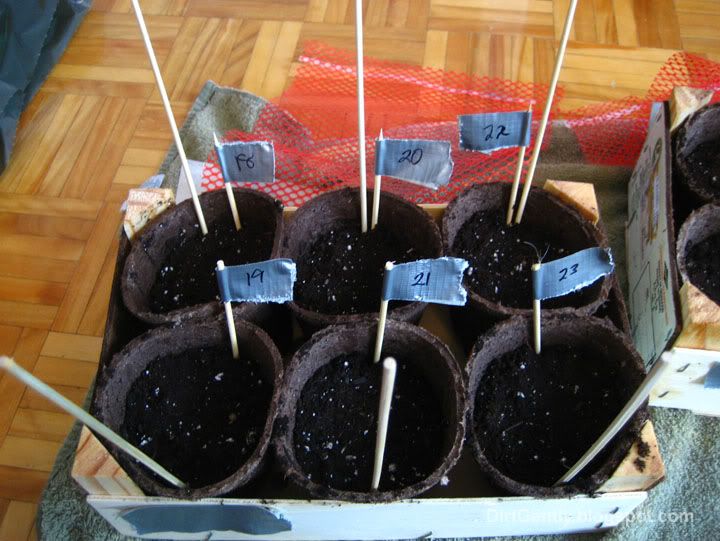
Finished wintersowing today. Some plants like the various Pulsatilla species and the blue poppy apparently don't like transplanting, so I sowed them in 4" peat pots, six pots to a tangerine crate. Each pot/crate set was placed inside a clear plastic bag with ventilation and drainage holes punched in it. I used little duct tape / BBQ skewer flags to identify each pot.


Final list of plants sown:
I'm beginning to wonder where I have room for all of these plants!

The mystery flower pod, by the way, look like these:

via Carol Parafenko's blog
Any idea what these are? I have no idea why I haven't documented these or entered these into my Folia seed stash database.

Tuesday, January 4, 2011

Wintersowing 2011 part 2

Here's my list of seeds that I have wintersowed so far this season:
Some other seeds I plan to wintersow also:
  • Black Pasque Flower (Pulsatilla pratensis subsp. nigricans)
  • Prairie Crocus (Pulsatilla patens)
  • Prairie Crocus red form (Pulsatilla vulgaris)
  • Poppy (Papaver somniferum)
  • Tibetan Poppy (Meconopsis betonicifolia)

Wintersowing 2011

I spent a little time during the first couple of days of 2011 getting ready for wintersowing. I've 15 containers so far, most of them clear. There are a couple of containers that are translucent, but I'm following the rule of thumb that if you can see your thumb through plastic, then it will be fine for wintersowing. Each container is very deep: there is enough space in each of them for up to 4 inches of medium, and plenty of headroom for the seedlings. Recommended minimum is 2 inches clearance.


The containers should be cleaned with 10% Clorox and air dried, but unusually for me, I skipped this step. I hope it doesn't come back to bite.

I labeled each container in several places with a number with permanent marker. To avoid being left with a bunch of unidentifiable seedlings due to the sun bleaching the container ID away while it's outside, I covered a couple of ID numbers on each container with duct tape.


Next, I cut each container almost all the way around , about 5" from the bottom to create a hinge.

Finally, I created holes (not slits) on bottom of container for drainage. It would have been ideal to use something like a soldering iron to create those holes, but I made do with a power drill and a fat bit. In retrospect, it would've been much easier to create the holes before creating the hinge. I will add holes to the top if the containers don't appear adequately ventilated; for now, leaving the containers uncapped will be the sole means of ventilation.


Next, I filled each container with medium (regular potting soil, not seed starting soil) up to 4 inches deep. Minimum recommended depth is 3 inches. I moistened the medium thoroughly and allowed the excess water to drain, and then sowed my seeds. Where required, I covered the sown seeds with medium.

Finally, I taped the bottom and top halves shut, and put the containers out on the balcony. I left the caps off for ventilation.

There are fifteen containers in all, some in the foreground of the picture, and some between the screen door and the planters at the top of the picture. I plan to wintersow more seeds come February.

Some other notes I gathered from Wintersown.org:
  • Control ventilation and drainage by increasing # of holes or taping them over. Start with 5 holes per container.
  • Some condensation on the lid is good - don't let the container dry out. No condensation or too much condensation is bad; adjust ventilation and drainage as above.
  • Harden off seedlings by increasing size of vents as spring warms up and transplant time approaches
  • No need to pot up: hunk o' seedlings method - grab a bunch and plant.
  • Don't let the flat overheat, especially as springs warms up.
  • Expect high germination percentages, but you will also have failures.
  • A couple of days after transplanting, fertilize seedlings at 1/4 strength. Every two weeks, increase to 1/3, then 1/2, then 3/4 strength fertilizer.